

The following solution is meant for those who live in a house with a “classic” electrical system based on stepper relays (step-by-step) and want to make it smart without gutting the electrical cabinet or losing the reliability of physical buttons.
Many people suggest replacing old relays with Wi-Fi modules (like Shelly or Sonoff), but I prefer a wired approach (RS485) that is much more reliable and consumes a very low power, much less than WiFi devices. Indeed, I want the system to keep working even if the domotic controller is down.
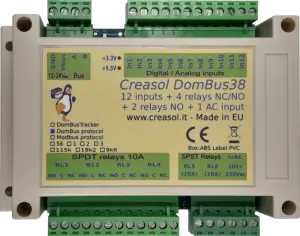
I’m using the Creasol DomBus33 , a DIN-rail module designed specifically for this “hybrid” integration.
How it works:
-
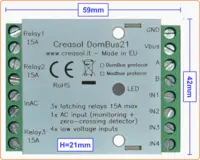
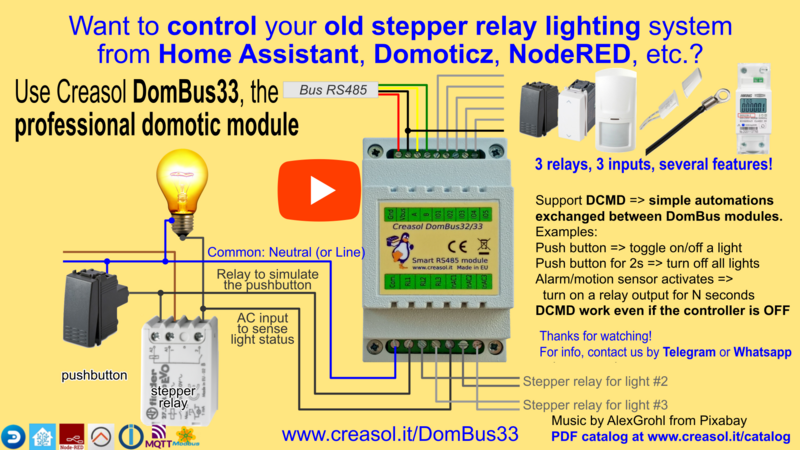
3 Relay Outputs: They connect in parallel to your existing 230V relay coils. They just send a short pulse to toggle the light on/off, exactly like your wall buttons do.
-
3 AC Inputs: These are connected to the stepper relay outputs (load side) to tell the domotic controller if the light is actually ON or OFF. No more guessing the state!
-
5 low voltage inputs: module has 5 inputs that can be connected to other pushbuttons switches (for example, you can program a button to turn off all lights), meters with pulse output (to measure energy, gas, water), alarm sensors (magnetic contacts, PIRs: even triple-biased sensors are supported), …
-
Low Power & Reliability: It works via RS485 bus (shielded cable), consuming only ~10mW. No Wi-Fi congestion or battery changes.
The best part? If domotic controller or the bus fails, your wall buttons continue to work perfectly because the original stepper relays are still there. It’s the ultimate “Wife Acceptance Factor” setup.
Also, DomBus modules support the “DCMD” commands: it’s possible to setup commands that works inside or between DomBus modules (similarly to KNX®) even if the domotic controller is down
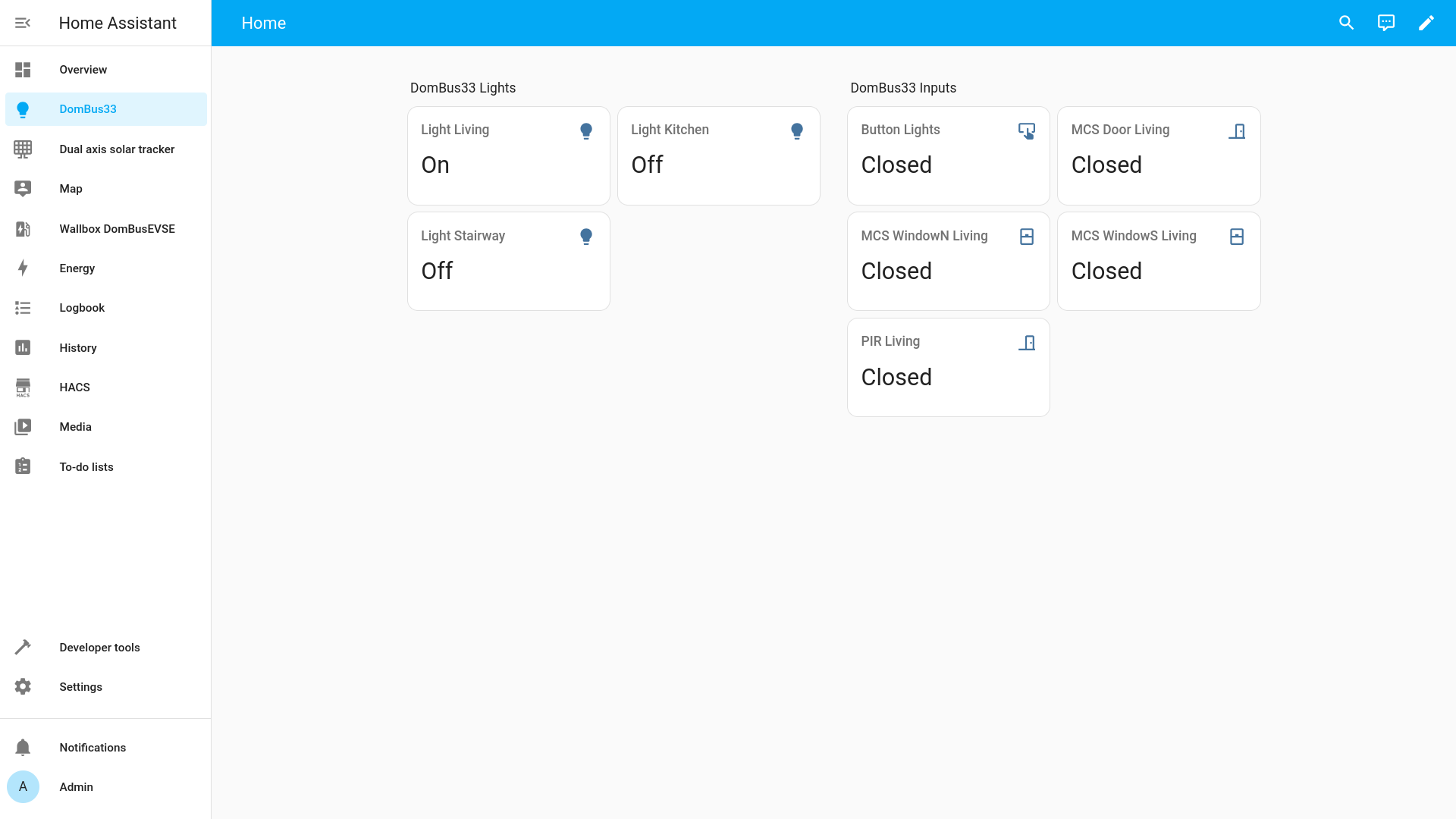
Integration with Home Assistant: It integrates easily via MQTT using the DomBusGateway add-on (AutoDiscovery supported) or via Modbus (not recommended for Domoticz, Home Assistant and other system working with MQTT). All entities appear automatically when you connect the module to the bus.
Of course you can connect many DomBus modules to the same bus!
You can find the full specs, wiring diagrams and video here: Creasol DomBus33 - Smart light controller, with 3 relay outputs, 3 AC inputs, 5 I/Os
Running electrical cables in a house may seem old-fashioned when wireless solutions are available, yet it has undeniable advantages in terms of reliability and power consumption: more than 500mW for WiFi, 10mW for DomBus: what happen when you have dozens of modules installed in your house?.
Moreover, RS485 cable (standard alarm cable, 4x0.22mm², can be used) is thin and easy to connect using any bus topology (linear, star, mixed), unlike LAN cable (which can only be connected in a star topology).
Has anyone else moved to a wired RS485 bus for their lights? We’d love to hear your thoughts on “Hybrid” vs “Full-Smart” replacements! Let us know by email, Telegram or Whatsapp!
Paolo - Italy
